
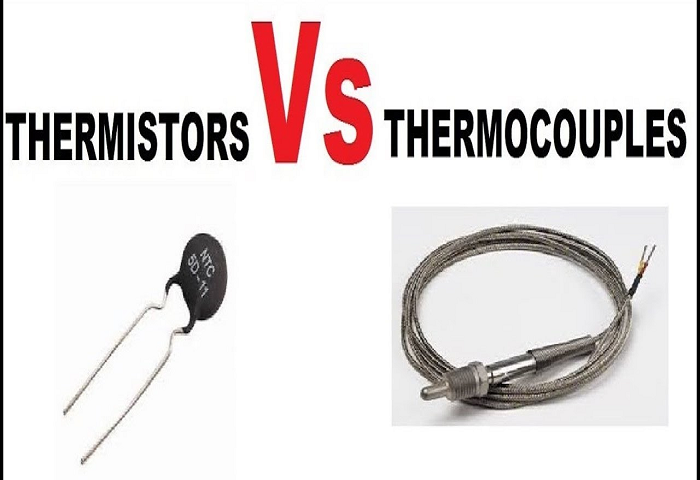
Both thermocouples and resistors are common temperature sensors that are employed in a variety of settings. They are very different and come with different features and operations. The differences between Thermistors vs Thermocouple, with their advantage and disadvantages, will be explained here.
Introduction
Numerous industrial and scientific applications require temperature sensing to function. To acquire precise and trustworthy temperature measurements, it’s critical to select the appropriate temperature sensor for your application. Thermistors and thermocouples are two popular varieties of temperature sensors. Both of these sensors are used for temperature measuring but they work in accuracy and response time
What is a Thermistor?
A common example of temperature is a thermistor that works on the basis of resistance changes with temperature. It is constructed from a ceramic or polymer material with a negative (NTC) or positive (PTC) temperature coefficient of resistance. The resistance of the thermistor adjusts to temperature changes, and this may be measured to determine the temperature.
.
Types of Thermistors
NTC and PTC are the two primary subtypes of thermistors. Because NTC thermistors have a negative temperature coefficient, as the temperature rises, so does their resistance. PTC thermistors have a positive temperature coefficient, meaning that as the temperature rises, so does their resistance.
Advantages and Disadvantages of Thermistors
Thermistors have several benefits, including low cost, high precision, and sensitivity. They are also quick to respond and simple to utilise. Thermistors do, however, have several drawbacks, including a constrained temperature range, self-heating, and nonlinearity at high temperatures.
What is a Thermocouple?
An example of a temperature sensor that utilizes the Seebeck effect is the thermocouple. It comprises two different metals linked together at one end to form a junction, usually nickel-chromium and nickel-aluminum. A voltage is produced at the junction when it is subjected to a temperature gradient, and this voltage may be measured to get the temperature.
Types of Thermocouples
The materials used for the wires and the temperature range that they can monitor are used to categorize the many types of thermocouples. K, J, T, E, and R thermocouples are a few popular varieties. Each variety has a unique temperature range and degree of precision.
Thermocouple Advantages and Disadvantages
The wide temperature range, great precision, and longevity in severe situations are all benefits of thermocouples. They do not need any extra power and are impervious to electromagnetic interference. Thermocouples do, however, have certain drawbacks, including a necessity for cold-junction correction and a lesser sensitivity, and a shorter reaction time.
Comparison Between Thermocouple vs Thermistor
The capacity to monitor temperature and their small size are two characteristics that thermocouple VA thermistor share. They vary, nonetheless, in terms of their traits and guiding principles. Compared to thermocouples, thermistors have sensitive nature and respond fastly but for small temperature values. While thermocouples have robust nature and high-temperature range, they are less sensitive and come with a slower reaction time. Furthermore, thermocouples provide a linear response while thermistors are a nonlinear response.
Which One to Choose: Thermistor or Thermocouple?
A thermistor or a thermocouple should be chosen according on the particular needs of your application. A thermistor is a better option if you need high sensitivity and rapid reaction time and the temperature range falls within its functioning range. A thermocouple is a superior option, though, if you need to detect temperature over a wide range and longevity in severe settings is important. When making your choice, it’s crucial to take each sensor’s price and accuracy into account.
.
Applications of Thermistors and Thermocouples
Thermistors and thermocouples are used in various applications, including:
- HVAC systems
- Automotive engines
- Medical equipment
- Industrial process control
- Food processing
- Aerospace
How to select the Right Temperature Sensor for Your Application
Choosing the right temperature sensor for your application involves several factors, including:
- Temperature range
- Accuracy
- Response time
- Sensitivity
- Durability
- Cost
By considering these factors, you can choose the temperature sensor that best fits your specific application requirements. Read Also!
Factors to Consider When Choosing a Temperature Sensor
Some additional factors to consider when choosing a temperature sensor include:
- Electrical noise
- Interference from other signals
- Power consumption
- Size and form factor
- Calibration requirements
By considering these parameters we can select the temperature sensor which provides best operation.


